
The Short Answer
Your garage door needs three things before storm season: a track and hardware in good condition, weatherstripping that actually seals, and an opener that won't strand the door half-open if the power cuts out. If any of those three are already weak, a hard nor'easter can turn a cosmetic problem into a structural one. The good news is that most of this can be checked and fixed now, before the wind starts.
Why the Garage Door Is a House's Weakest Wall
Every other exterior wall on your home is a rigid, fastened assembly. The garage door is not. It's a large panel of jointed sections riding in a thin metal track, held in place by rollers, hinges, and a spring system doing most of the structural work. When wind hits a flat garage door face-on, it doesn't just push—it creates pressure that tries to bow the panels outward and inward in gusts, which is exactly the kind of cyclical load that pops rollers out of track, bends panels, or tears an opener's drive mechanism off its bracket.
Once a garage door fails during a storm, the problem doesn't stay contained to the garage. Wind that gets inside through a breached garage door pressurizes the whole house from the inside, putting stress on the roof structure and other openings. That's the real reason garage doors get singled out in wind-resistance discussions: they're the largest, least reinforced opening in most homes.
Why Older Chatham-Area Housing Needs Extra Attention
A lot of homes in this part of Morris County still have their original garage doors, sometimes original tracks and hardware too. Older doors were often built to lighter-duty standards than what's manufactured today, and decades of freeze-thaw cycles, road salt, and humid summers take a steady toll on steel components. Surface rust on hinges and track brackets isn't just cosmetic—it weakens the exact hardware that's supposed to keep the door seated in high wind. If your door and opener predate the last major renovation on the house, it's worth a closer look before storm season rather than after.
What to Check Before the Next Storm Rolls In
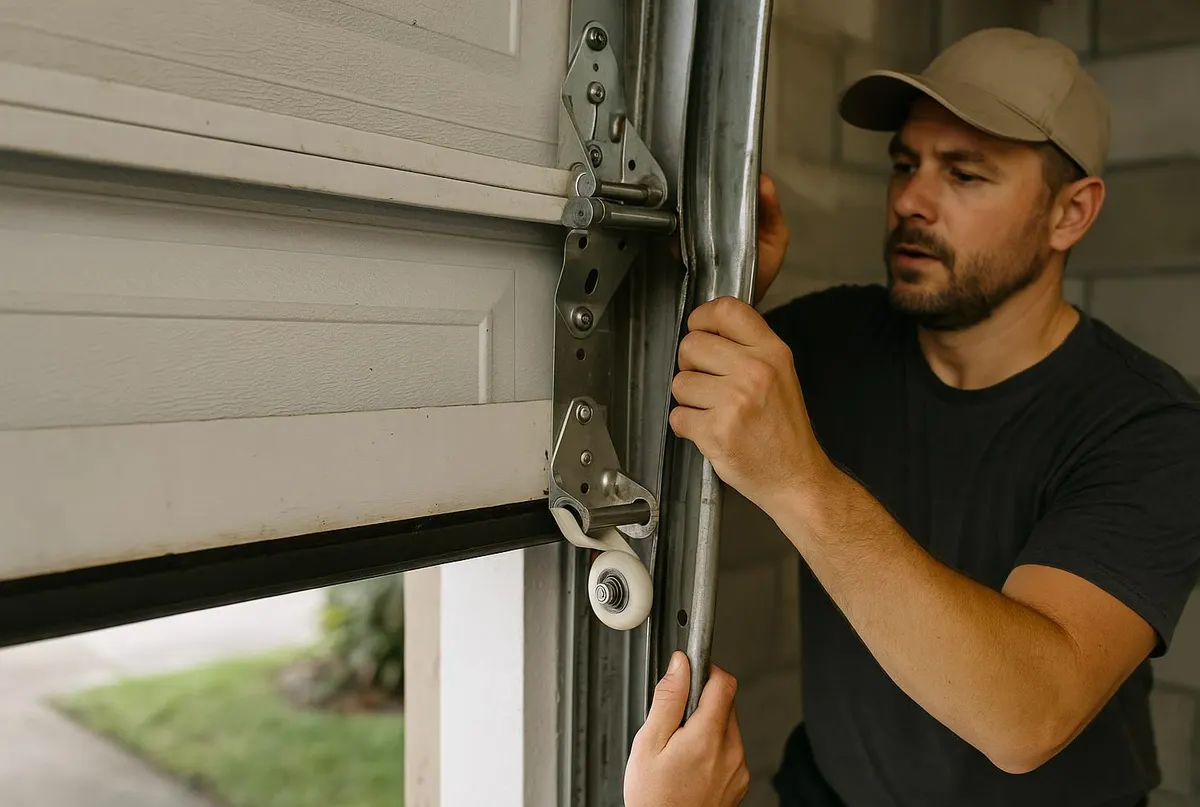
- Track alignment: Stand back and look at both vertical tracks. They should be parallel with no visible gaps between rollers and track wall. Gaps widen under wind load.
- Roller condition: Worn or cracked rollers (plastic ones especially) are a common failure point. Metal rollers with sealed bearings hold up better long-term.
- Panel hardware: Hinges, struts, and end brackets should be tight, not just present. Loose lag screws in an older wood jamb are a frequent issue in this area's housing stock.
- Weatherstripping and bottom seal: Cracked or flattened seals let wind-driven rain in during a nor'easter and also mean the door isn't sitting as snugly as it should.
- Opener force settings and auto-reverse: If the opener strains, reverses unexpectedly, or struggles near the top or bottom of travel, that's a sign of spring imbalance, not just an opener problem.
- Battery backup: Nor'easters regularly knock out power along with wind. A battery backup on the opener means you're not stuck with a door frozen in whatever position it was in when the power dropped.
Reinforcement Options Worth Considering
If your inspection turns up more than minor wear, there are a few practical upgrades:
- Horizontal or vertical bracing kits add rigidity to the panel itself, reducing flex under wind load. These are a reasonable middle step short of full replacement.
- Heavier-duty tracks and end brackets hold up better to repeated wind cycling than the lighter track common on older residential doors.
- Upgraded rollers (steel, sealed-bearing) are a low-cost swap that meaningfully reduces the chance of a roller jumping track during gusts.
- Full door replacement makes sense when the panels themselves are already dented, warped, or rusted through—reinforcing a compromised panel just delays the inevitable. New insulated steel doors, as a general price range, tend to run from the low thousands up to several thousand dollars depending on size, insulation, and window options; it's a real investment but one that also improves energy efficiency through the freeze-thaw months.
What to Do in the Days Before a Storm Hits
- Clear leaves and debris from the track and bottom seal—wet leaves packed into the bottom of the door prevent a full seal.
- Lubricate rollers and hinges with a garage-door-specific lubricant, not WD-40, which washes out and attracts grit.
- Keep the door closed as much as possible during high-wind warnings; an open or partially open door catches wind like a sail.
- If you have a battery backup, confirm it's actually holding charge, not just installed and forgotten.
When to Call Chatham Garage Door
If your inspection turns up rust-weakened hinges, a track that's pulling away from the wall, or an opener that strains and reverses on its own, those are structural warning signs, not maintenance trivia, and they're worth addressing before the next big storm rather than after. Chatham Garage Door handles seasonal Garage Door Maintenance visits that cover exactly this kind of inspection—track alignment, hardware torque, roller and seal condition—and if something's already failed or a spring lets go mid-storm, our Emergency Garage Door Service is built for that call, day or night.
If you're in Chatham, Madison, Summit, New Providence, Florham Park, Short Hills, Millburn, or Livingston and want your garage door checked before the next nor'easter comes through, call Chatham Garage Door today and get it handled before the wind does.